
Title and statement of responsibility area
Title proper
General material designation
Graphic material
Parallel title
Other title information
Title statements of responsibility
Title notes
Level of description
Reference code
Edition area
Edition statement
Edition statement of responsibility
Class of material specific details area
Statement of scale (cartographic)
Statement of projection (cartographic)
Statement of coordinates (cartographic)
Statement of scale (architectural)
Issuing jurisdiction and denomination (philatelic)
Dates of creation area
Date(s)
-
January 27, 1955 (Creation)
Physical description area
Physical description
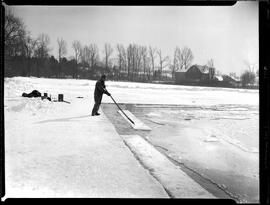
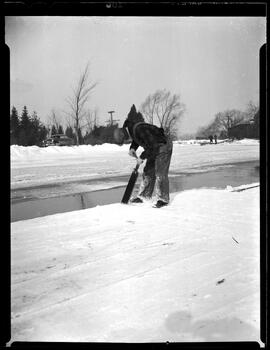
7 photographs : b&w negatives ; 8 x 11 cm
Publisher's series area
Title proper of publisher's series
Parallel titles of publisher's series
Other title information of publisher's series
Statement of responsibility relating to publisher's series
Numbering within publisher's series
Note on publisher's series
Archival description area
Name of creator
Custodial history
Scope and content
Notes area
Physical condition
Immediate source of acquisition
Arrangement
Language of material
Script of material
Location of originals
Availability of other formats
Envelope scanned as TIF files November 2018.
Restrictions on access
Terms governing use, reproduction, and publication
Public Domain
Finding aids
Associated materials
Accruals
General note
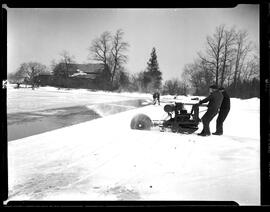
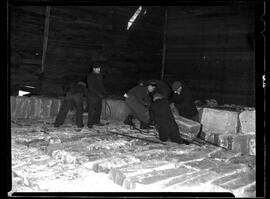
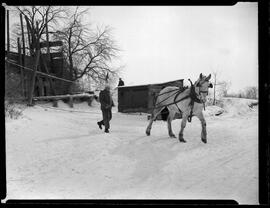
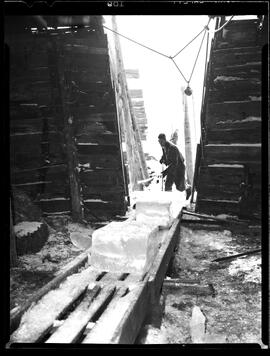
55-6960_001 and four photos missing from envelope appeared on Page 11 of the Saturday, January 29, 1955 edition of the newspaper as part of the article: "Old-Time Methods Still Used in Harvesting Ice".
General note
Photo caption from published version of 55-6960_001 and photo missing from envelope : "STILL A DEMAND - In this modern age there is still a demand for natural ice. Cutting operations at Blair dam are handled almost the same way they were 50 years ago with one exception, a power saw does most of the work. Strips are cut length-wise (left photo) [see 55-6960_005 for closest version] then cross-wise (right photo) [55-6960_001] while a man with a hand saw trims the ice to 15-inch size."
General note
Photo caption from published photo [see 55-6960_003 for closest version]: "HORSEPOWER - A single horse is used to hoist the ice from the dam to the icehouse. A steel hook is attached to the blocks of ice and as the horse walks the ice moves along the crude wooden conveyor to be lifted into the storage loft".
General note
Photo caption from published photo [see 55-6960_002 for closest version]: "PACKING CREW - A five-man packing crew works at slugging the heavy blocks into neat rows in the ice house Fourteen men are used in the old time operation."
General note
Photo caption from missing photo [no suitable substitute]: "SIZING - The large blocks are floated to a channel where two men break them into smaller pieces".